

Why Glass-Mounted Security Cameras Are Booming in 2026 (Market Data + Expert Analysis)

Home security has never been more popular — yet a large and growing portion of the market is locked out of the most common solution. Rental tenants can’t drill into walls. HOA-restricted homeowners face fines for exterior hardware. Condo dwellers can’t mount anything outside their unit.
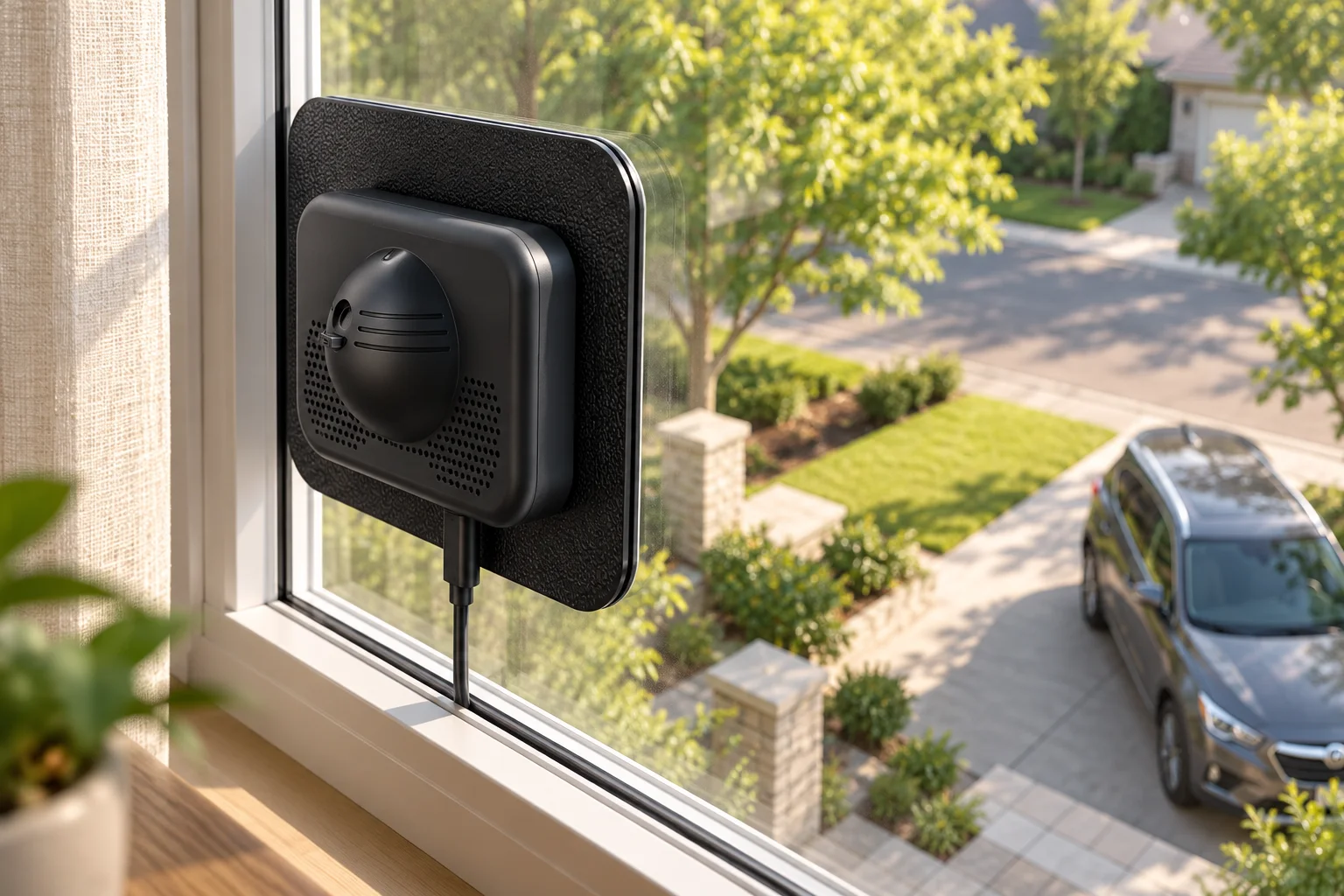
This gap is fueling one of the fastest-growing niches in residential security: glass-mounted cameras that attach directly to windows from the inside, requiring no exterior access, no drilling, and no landlord approval.
Here’s a data-driven look at why this category is growing — and why it’s likely to keep growing through the rest of this decade.
The Numbers: Security Camera Adoption Is Accelerating
The broader security camera market has reached an inflection point. Adoption rates have jumped significantly in just two years:
|
61%
of U.S. households now own at least one security camera
SafeHome.org, 2026 Home Security Market Report
|
74.9M
American homes have security cameras installed as of 2026
SafeHome.org, 2026 Home Security Market Report
|
|
22.1%
annual growth rate for smart home security cameras projected through 2033
Grand View Research, 2025
|
$56.5B
projected smart home camera market size by 2033, up from $11.77B in 2025
Grand View Research, 2025
|
That jump from 52% adoption in 2024 to 61% in 2026 represents tens of millions of new camera buyers entering the market in just two years. But the growth story has a structural problem: the customers growing fastest don’t fit the traditional installation model.
The Structural Problem: 36% of Americans Can’t Drill
The standard home security camera assumes a homeowner who can drill into exterior walls, run cables, and make permanent modifications. That describes fewer than two-thirds of American households.
According to U.S. Census Bureau data, approximately 36% of Americans rent their homes — roughly 44 million households. For these renters, the typical instructions that come with an outdoor security camera are immediately disqualifying: “drill a 1-inch hole through the exterior wall,” “run the power cable to an outdoor outlet,” “mount the bracket using the included anchors.”
Lease agreements almost universally prohibit structural modifications. A renter who drills into an exterior wall risks losing their security deposit — or their lease entirely. The result: tens of millions of households that want cameras but genuinely cannot use outdoor-mounted ones.
“The fastest-growing segment of the residential security camera market is installation-free and renter-friendly solutions. Consumers don’t want to give up security just because they’re renting.”
— Home Security Camera Trends 2025
The HOA Factor: 75 Million More Buyers Blocked
Renters aren’t the only segment blocked from traditional exterior cameras. An estimated 75 million Americans live in HOA-governed communities, many of which have strict regulations on exterior modifications and visible hardware.
Common HOA camera restrictions include:
- No visible camera hardware on exterior walls or rooflines
- No equipment that alters the exterior appearance of the unit
- Camera brackets must match approved materials and colors
- Prior approval required for any exterior installation
A glass-mounted camera installed entirely inside the unit sidesteps these restrictions entirely: it’s invisible from the street, requires no exterior hardware, and typically doesn’t require HOA approval.
Why Standard Cameras Fail Through Glass — and How That’s Changed
For years, “can I point a camera through a window?” had a simple answer: no. Standard cameras rely on internal infrared LEDs for night vision. When those LEDs fire inside a room with a window, the infrared light bounces off the glass and back into the lens — creating a bright white reflection that washes out any outdoor image.
The glass-mounting category overcomes this in two ways:
- Physical contact mounting: Suction-cup designs press the lens directly against the glass, eliminating the air gap that causes reflection. No gap means no bounce-back.
- External IR projector: Instead of internal LEDs that reflect off glass, purpose-built window cameras use external IR illuminators positioned to project outward — not toward the glass surface.
Professional Evaluations: What Reviewers Look For
Key evaluation criteria for glass-mounted cameras, based on professional testing:
| Evaluation Criteria | What Reviewers Look For | Why It Matters |
|---|---|---|
| Night vision quality | External IR projector, not internal LEDs | Internal LEDs cause glass reflection and white-out |
| Suction strength | Hold duration on smooth and textured glass | Camera must stay in position without sliding |
| Glare elimination | Lens-to-glass seal quality | Air gap = glare; direct contact = clear image |
| Local storage | SD card or eMMC storage included | No mandatory cloud subscription |
| Installation time | Under 10 minutes, no tools required | Key differentiator for the renter use case |
Market Drivers: Why Growth Will Continue
RECOMMENDED PRODUCT
ShowMo WinEye
4K Window Camera · No Drill · No Monthly Fee
Glare-free IR cut filter, built-in eMMC storage. Perfect for renters and apartments.
1. Rental Housing Is Growing, Not Shrinking
Housing costs have pushed more Americans into the rental market. The Urban Institute projects that the renter share of U.S. households will continue rising through 2030. Each percentage point of renter growth adds approximately 1.2 million new households to the “can’t drill” market.
2. Smart Home Integration Is Becoming Standard
The wireless home security camera market was valued at $11.3 billion in 2025 and is projected to grow at a CAGR of 12.1% through 2035 (GM Insights). As smart home adoption spreads, demand for easy-to-install, wireless-first security solutions grows with it — and glass-mounted cameras fit this profile precisely.
3. Camera Quality Has Reached Parity
Early glass-mounted cameras were compromise products — lower resolution, limited night vision, unreliable app connections. The current generation has closed that gap. 4K resolution, 64GB built-in storage, and full smart home app integration are now available in window-mounted form factors.
4. Regulatory Awareness Is Rising
More renters and condo owners are becoming aware of their rights and limitations regarding security cameras. As that awareness grows, so does demand for solutions that don’t require negotiating with landlords or HOAs.
The ShowMo WinEye: Purpose-Built for Glass
The ShowMo WinEye is designed from the ground up for glass installation — not adapted from an outdoor camera design.
| Specification | WinEye |
|---|---|
| Mounting | Suction cup — direct glass contact, no air gap |
| Resolution | 4K (WinEye Pro) / 1080p HD |
| Night vision | External IR projector — no internal LEDs that reflect off glass |
| Local storage | 64GB built-in eMMC (Pro) — no cloud subscription required |
| Installation | Under 5 minutes, no tools required |
| HOA-friendly | Entirely interior — no exterior hardware visible from outside |
| Compatible glass | Single-pane, double-pane, lightly tinted glass |
| Audio | Two-way audio via ShowMo app |
Frequently Asked Questions
Q: Is a glass-mounted camera as effective as an outdoor-mounted camera?
A: For most residential use cases — driveways, front paths, yards — yes. Purpose-built glass-mounted cameras like the WinEye deliver 4K resolution and night vision comparable to outdoor cameras, without weatherproofing requirements.
Q: Will my landlord or HOA have a problem with a glass-mounted camera?
A: In most cases, no. Glass-mounted cameras are installed entirely inside your unit and leave no marks on the glass or walls. Most leases and HOA rules allow interior camera placement.
Q: Does glass-mounted work on all window types?
A: Standard single-pane and double-pane windows work well. Lightly tinted glass has no impact. Low-E glass with metallic coating can reduce IR night vision range.
Q: What’s the difference between a glass-mounted camera and pointing a regular camera at a window?
A: Significant. A regular camera pointed at a window captures glare, reflections, and IR bounce-back — especially at night. A glass-mounted camera physically contacts the glass to eliminate these problems by design.
Bottom Line
The glass-mounted security camera category is growing because it solves a genuine, structural problem: tens of millions of would-be camera buyers who are legally or practically prevented from using traditional outdoor-mounted solutions.
With rental housing growing, smart home adoption accelerating at 22.1% annually, and camera technology reaching feature parity with outdoor alternatives, the conditions for continued growth are firmly in place.
See WinEye Full Specifications →
RECOMMENDED PRODUCT
ShowMo WinEye
4K Window Camera · No Drill · No Monthly Fee
Glare-free IR cut filter, built-in eMMC storage. Perfect for renters and apartments.