
Wi-Fi HaLow Security Camera: The Complete 2026 Guide (802.11ah Range Explained)

You’ve probably heard the pitch for standard wireless security cameras: easy setup, no cables, works anywhere. What the pitch leaves out is the range: 150–300 feet on a good day, degrading fast through walls, trees, and interference. For anyone who needs to monitor a gate 600 feet away, a barn at the edge of the property, or any location without reliable cellular signal, standard Wi-Fi cameras simply don’t reach.
Wi-Fi HaLow changes that equation completely. In 2026, it’s the most capable long-range wireless camera technology available — and the ShowMo MileFlask is the leading purpose-built implementation. This guide explains the technology, the hardware, and who actually needs it.
What Is Wi-Fi HaLow (802.11ah)?
Wi-Fi HaLow is an official Wi-Fi Alliance standard (IEEE 802.11ah) ratified in 2016 and entering widespread commercial deployment from 2023 onward. Unlike conventional Wi-Fi, which operates at 2.4 GHz and 5 GHz, HaLow operates at 900 MHz — a sub-gigahertz frequency with fundamentally different propagation characteristics.
The physics of lower-frequency signals mean three distinct advantages:
- Greater range: Lower frequency = longer wavelength = signals travel farther before attenuating. A 900 MHz signal carries 5–10× farther than a 2.4 GHz signal at equivalent power.
- Better obstacle penetration: Lower-frequency waves diffract more readily around obstacles like trees, hills, and building corners rather than reflecting off them.
- Lower power consumption: HaLow transmits efficiently at low data rates, making battery and solar operation practical over long distances.
The tradeoff is bandwidth: HaLow tops out at about 40 Mbps under ideal conditions, versus hundreds of Mbps for Wi-Fi 6. But security camera video only needs 2–8 Mbps for 1080p or 4K footage — HaLow delivers that at ranges no other standard Wi-Fi can match.
HaLow vs. Standard Wi-Fi: The Technical Comparison
| Specification | Wi-Fi 5/6 (802.11ac/ax) | Wi-Fi HaLow (802.11ah) |
|---|---|---|
| Frequency | 2.4 GHz / 5 GHz | Sub-1 GHz (900 MHz) |
| Outdoor range | 100–300 ft (30–90m) | 1,000–5,000 ft (300m–1.5km+) |
| Obstacle penetration | Poor (reflects, attenuates) | Excellent (diffracts around obstacles) |
| Max bandwidth | 100–1,200+ Mbps | 1–40 Mbps (sufficient for HD/4K video) |
| Power consumption | Moderate–High | Low (solar/battery compatible) |
| Monthly fee | None | None |
| Requires ISP internet | Yes (at router) | Yes (at base station only) |
How a Wi-Fi HaLow Camera System Works
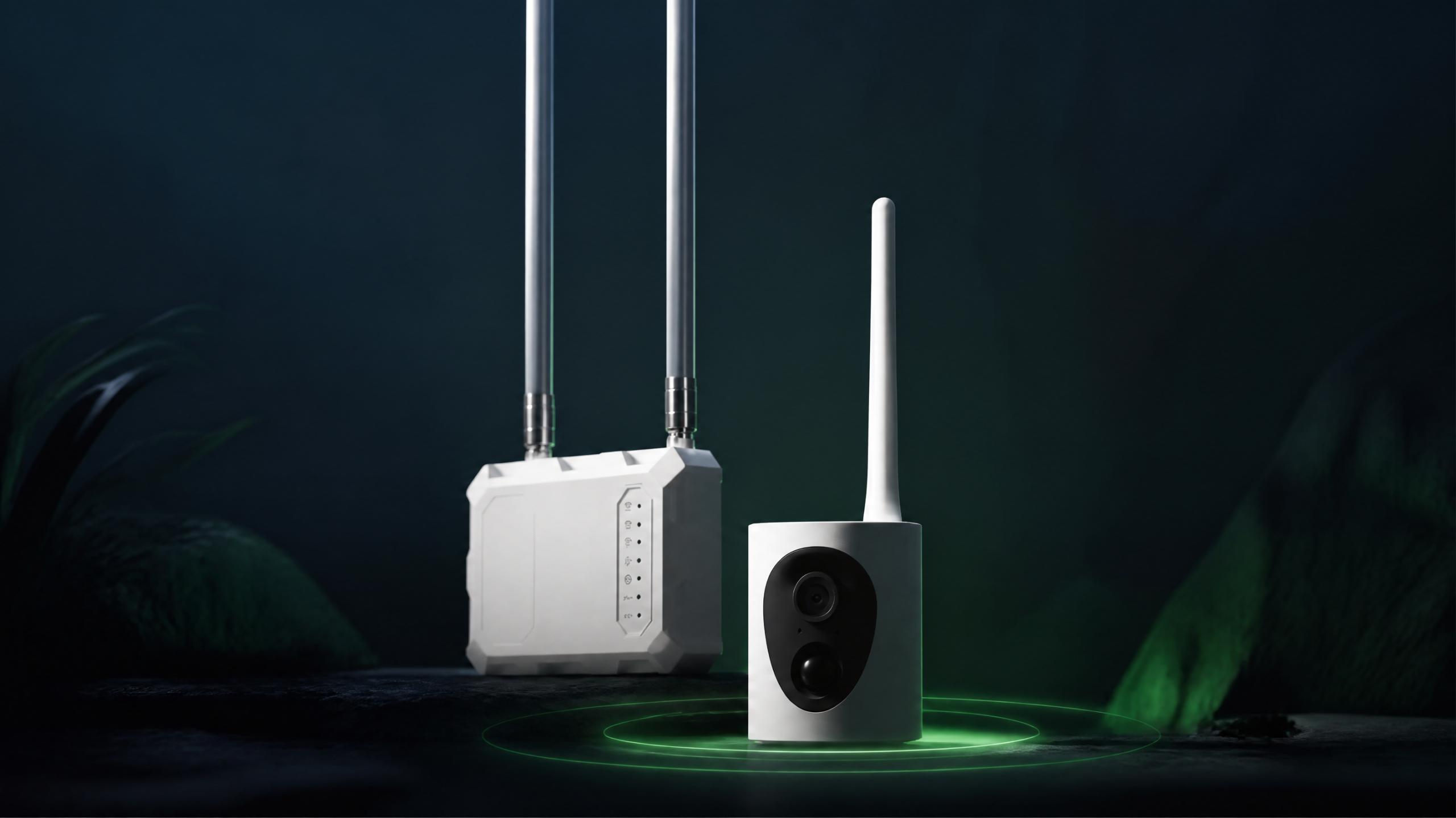
A HaLow camera system has two components: a base station (called the MileHub in the MileFlask system) connected to your home internet, and one or more HaLow cameras positioned anywhere within HaLow range.
The signal chain works like this:
- Your home router connects to the internet as normal via your ISP
- The MileHub plugs into your router via Ethernet (or connects via standard Wi-Fi) and begins broadcasting a HaLow signal
- The MileFlask camera, anywhere within 1+ mile range, receives the HaLow signal and connects automatically
- Live video streams from the camera to your ShowMo app via the HaLow link → MileHub → internet → your phone
- Motion events are recorded locally to the camera’s SD card regardless of internet connectivity
The key point: only the base station needs to be near your internet connection. The cameras can be placed anywhere in range — and “in range” means a radius of over a mile in open terrain.
ShowMo MileFlask: The Leading HaLow Security Camera in 2026
The ShowMo MileFlask is powered by the Morse Micro MM6108 chipset — the most widely deployed commercial HaLow silicon — and is purpose-built for outdoor security at distances conventional cameras can’t reach.
| Specification | MileFlask |
|---|---|
| Wireless standard | Wi-Fi HaLow (802.11ah) — Morse Micro chipset |
| Rated range | Up to 1 mile (1.6 km) in open terrain |
| Validated range | 3.5 km HD video — CES 2026 joint demo with Morse Micro |
| Resolution | 1080p HD |
| Storage | Local SD card + optional NAS support |
| Monthly fee | $0 — no cloud subscription required |
| Weatherproofing | IP65 — rain, dust, -20°C to 60°C |
| Power options | Standard adapter or solar panel compatible |
| Base station | MileHub — connects to existing home router |
HaLow vs. Cellular vs. PoE: Which Technology Wins Where
| Factor | Wi-Fi HaLow (MileFlask) | Cellular 4G LTE | PoE (Wired) |
|---|---|---|---|
| Range limit | 1+ mile from hub | Needs cell signal | Cable length (~300ft) |
| Monthly cost | $0 | $10–30/cam | $0 |
| Install cost | Low (wireless) | Low (wireless) | High ($2k–8k trenching) |
| No cell signal? | Works fine | Completely fails | Works (local NVR) |
| Solar compatible | Yes | Yes | No |
| Best for | Large properties, farms, no cell signal | Urban/suburban, moderate range | Fixed installations, high reliability |
Real-World Performance: The CES 2026 Validation
RECOMMENDED PRODUCT
ShowMo MileFlask
Wi-Fi HaLow · Up to 1-Mile Range · No Monthly Fees
Perfect for farms, large properties, and anywhere standard Wi-Fi doesn’t reach.
In January 2026, ShowMo and Morse Micro jointly demonstrated the MileFlask system at CES 2026, transmitting sustained HD video over a 3.5 km (2.2 mile) open-field link. The test ran continuously for several hours, transmitting 1080p video with sub-2-second latency throughout.
The Morse Micro MM6108 chipset used in the MileFlask is the same silicon deployed in industrial IoT applications requiring reliable long-range connectivity. It is not experimental hardware — it’s production-grade silicon shipping in commercial products.
Practical performance benchmarks for typical property layouts:
- 150–500 ft (wooded terrain): Rock-solid 1080p, unaffected by tree canopy
- 500–1,500 ft (mixed terrain): Reliable HD video with occasional brief latency spikes
- 1,500–3,000 ft (open terrain): Consistent connection, 1080p video sustained
- 3,000 ft–1 mile (open field): Achievable under clear conditions; tested to 3.5 km at CES
The 3.5 km CES demonstration wasn’t a best-case lab test — it was an uncontrolled outdoor environment with real-world signal conditions. That matters when evaluating rated range claims.
Who Actually Needs a Wi-Fi HaLow Camera
Farm and Ranch Owners
No Wi-Fi in the barn. No cell signal in the north pasture. The MileFlask was built specifically for this use case. One MileHub at the farmhouse covers the entire property — grain silos, equipment sheds, entry gates — with a single base station investment and zero monthly fees.
Large Residential Properties
A 5-acre lot with gates 800 feet from the house, a detached workshop, and a waterfront dock at 600 feet — these are all easily within HaLow range. Standard Wi-Fi extenders and mesh nodes don’t reach reliably; HaLow does.
Vacation Properties and Cabins
Remote cabins may have satellite internet (Starlink) or no internet at all. The MileFlask stores footage locally even without connectivity, and when the satellite link is up, the ShowMo app syncs alerts and live view automatically.
Construction and Job Site Security
Equipment theft costs U.S. construction $1 billion annually. A MileFlask system covers a large job site from a portable MileHub powered by a temporary connection — deployed in under an hour, relocated when the project moves.
Frequently Asked Questions
Q: Do I need a special router for Wi-Fi HaLow?
A: No. The MileHub base station connects to any standard router via Ethernet or Wi-Fi. Your home network doesn’t need any modifications — the MileHub handles all HaLow communication independently.
Q: Can the MileFlask work without any internet connection?
A: Yes for local recording. The camera saves footage to its SD card continuously regardless of internet status. Live remote viewing and push notifications require an active internet connection at the MileHub location.
Q: Is Wi-Fi HaLow safe from interference?
A: The 900 MHz sub-GHz band is less congested than 2.4 GHz and 5 GHz Wi-Fi. In rural and semi-rural environments, there is typically very little interference on the HaLow frequency band.
Q: How does 1-mile range hold up in heavily wooded terrain?
A: HaLow’s 900 MHz signal penetrates vegetation significantly better than 2.4 GHz. In dense woodland, expect 50–70% of the open-field range. A wooded property covering 800 feet typically remains fully in range.
Q: How many cameras can connect to one MileHub?
A: The HaLow protocol supports thousands of nodes theoretically; practical MileFlask system limits depend on your bandwidth allocation. Contact ShowMo for configuration guidance on multi-camera deployments.
Q: Is the MileFlask compatible with other smart home systems?
A: The ShowMo app provides the primary interface. For integrations with specific smart home platforms, contact ShowMo support for current compatibility details.
Bottom Line
Wi-Fi HaLow (802.11ah) is not a incremental upgrade to standard Wi-Fi — it’s a fundamentally different signal type engineered for range and obstacle penetration at the cost of raw bandwidth. For security cameras, that tradeoff is exactly right: you need range and reliability, not multi-gigabit throughput.
The ShowMo MileFlask is the most field-validated implementation available in 2026, with a 3.5 km public demonstration and a production-grade chipset from the leading HaLow silicon vendor. If your camera needs to reach anywhere a standard Wi-Fi signal can’t, this is the technology — and this is the camera.
RECOMMENDED PRODUCT
ShowMo MileFlask
Wi-Fi HaLow · Up to 1-Mile Range · No Monthly Fees
Perfect for farms, large properties, and anywhere standard Wi-Fi doesn’t reach.