
Night Vision Security Camera Through Window: Does IR Cut Filter Help?
Home security technology has advanced remarkably, offering peace of mind to homeowners everywhere. One popular solution is using security cameras to monitor the exterior of your property. But what if you can’t install cameras outside? The idea of placing a night vision security camera through a window often comes to mind. It seems like a brilliant workaround: indoor camera, outdoor view, no drilling required. However, many quickly discover a frustrating issue: glass reflections ruining their night vision footage. This common problem leads to a crucial question: does an IR cut filter help when using a night vision camera through a window?
In this comprehensive guide, we’ll delve deep into the intricacies of using security cameras behind glass, explore the role of IR illumination and filters, and reveal the best solutions for achieving clear night vision from an indoor vantage point. We’ll also introduce an innovative product designed specifically for this challenge.
The Challenge of Night Vision Through Glass: Internal IR Reflection
To understand why night vision cameras struggle through windows, we first need to grasp how night vision works. Most security cameras utilize infrared (IR) illuminators – small LED lights that emit infrared light, invisible to the human eye. This IR light bounces off objects in the dark scene and is then captured by the camera’s sensor, allowing it to “see” in low-light conditions. This is what creates those characteristic black and white night vision images.
When you place an IR-equipped camera behind a window at night, the internal IR illuminators are fired up. However, instead of penetrating the glass to illuminate the outdoor scene, a significant portion of this IR light reflects directly off the inner surface of the windowpane. This reflection creates a blinding glare or a hazy, washed-out image, rendering the night vision practically useless for outdoor monitoring.

This phenomenon isn’t a camera malfunction; it’s a fundamental property of light interacting with glass. The glass acts like a mirror to the camera’s own IR light, effectively sabotaging its ability to see outside.
What is an IR Cut Filter and How Does it Work?
An IR cut filter (also known as an IR filter or IR-blocking filter) is a crucial component within most modern security cameras. Its primary function is to block infrared light from reaching the camera’s sensor during daylight hours. Here’s why this is important:
- Daytime Color Accuracy: Without an IR cut filter, the camera’s sensor would pick up both visible light and infrared light during the day. Since the human eye doesn’t perceive IR, this would result in distorted colors, often with a reddish or purplish tint. The IR cut filter ensures that only visible light is recorded, producing accurate and vibrant colors in daylight footage.
- Nighttime Sensitivity: When the camera switches to night mode, the IR cut filter is mechanically removed or retracted. This allows the camera’s sensor to become fully sensitive to infrared light, which is essential for capturing images illuminated by the camera’s IR LEDs or ambient IR light.
So, an IR cut filter is designed to manage IR light, not to eliminate reflections. It’s an internal mechanism that dictates when IR light is allowed to hit the sensor. Therefore, while vital for camera functionality, an IR cut filter itself does not directly solve the problem of internal IR reflection when a camera is placed behind glass.
The “Glass Mode Security Camera” Solution: Disabling Internal IR
Since the issue stems from the camera’s own IR illuminators reflecting off the glass, the most effective solution is to prevent those illuminators from turning on. This is where the concept of a “glass mode security camera” comes or cameras with a “window mode” feature becomes critical.
A true glass mode or window mode setting in a security camera does the following:
- Disables Internal IR Illuminators: This is the cornerstone of the solution. By turning off the camera’s built-in IR LEDs, there’s no IR light to reflect off the windowpane.
- Maintains Night Vision Sensitivity (Often): The camera’s sensor still needs to be able to “see” in the dark. In glass mode, the IR cut filter is typically still retracted at night, allowing the sensor to capture any available ambient light, including streetlights, moonlight, or light from external IR illuminators.
- Potentially Adjusts Exposure/Gain: Some advanced glass mode cameras may further optimize their settings to enhance low-light performance when internal IR is disabled, trying to make the most out of existing light.
With internal IR off, the camera relies solely on ambient light or, ideally, an external, separately placed IR illuminator positioned outside the window. This setup completely bypasses the reflection problem, allowing the camera to capture clear images of the outdoor environment.
Comparison: Standard Night Vision vs. Glass Mode/External IR
| Feature/Scenario | Standard Night Vision (Through Window) | Glass Mode / External IR (Through Window) |
|---|---|---|
| Internal IR Illuminators | ON | OFF |
| IR Reflection Issue | SEVERE (blinding glare) | NONE |
| Night Vision Clarity | Poor to unusable | Good to excellent (depending on external light/IR) |
| Reliance on Ambient Light | Attempts, but often overwhelmed by reflection | Primary source if no external IR |
| Best Use Case | Indoor use (not through window) | Outdoor viewing from indoors (requires external light/IR) |
| Installation Complexity | Simple (for camera positioning) | Slightly more complex (positioning external IR if needed) |
Maximizing Night Vision Quality Through a Window
Even with a security camera featuring a “glass mode” or the ability to disable IR, there are several steps you can take to further improve your night vision footage:
- External IR Illuminators: This is the gold standard. Place a dedicated, weather-resistant IR illuminator outside the window, pointing in the same direction as your camera. Since the IR source is outside the glass, there’s no reflection, and the camera, with its internal IR off, will pick up the illuminated scene clearly.
- Disable Indicator Lights: Many cameras have status LEDs (blue, green, etc.) that can also cause reflections. Make sure to disable these in the camera’s settings if possible.
- Minimize Internal Light: Any light inside the room where the camera is placed can cause unwanted reflections. Keep the room as dark as possible at night. Avoid placing the camera near lamps or TVs.
- Positioning and Angle: Position the camera as close to the glass as possible, ideally pressing gently against it. This minimizes the air gap where reflections can occur. Experiment with slight angles to reduce glare from ambient indoor lights.
- Clean Glass: This might seem obvious, but a dusty or smudged windowpane can significantly degrade image quality, especially at night.
- Motion Detection Sensitivity: With potentially less light, you might need to adjust motion detection settings to avoid false alarms or missed events.
Product Spotlight: ShowMo WinEye – The Ultimate Window Camera Solution
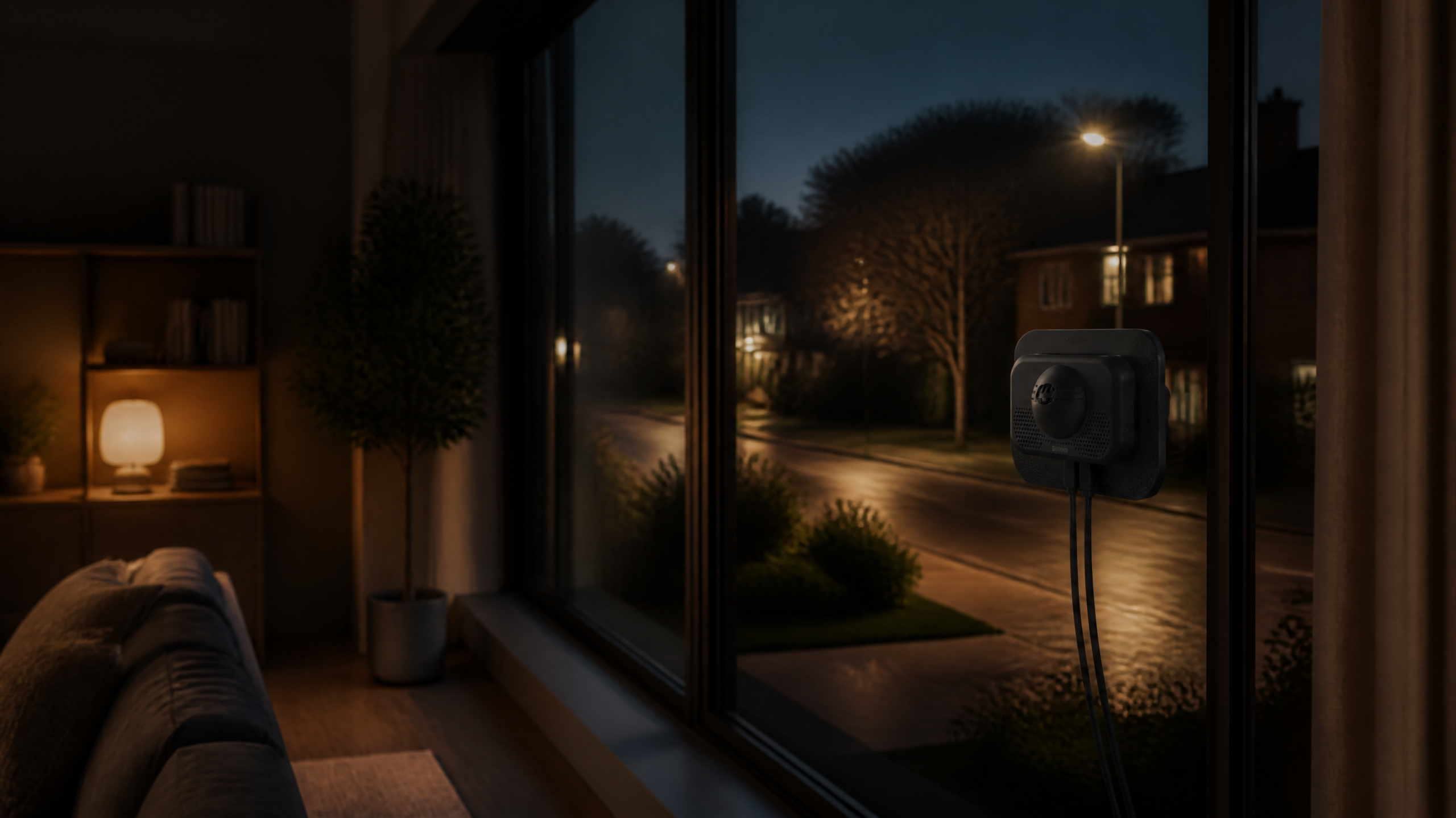
Understanding these challenges, ShowMo has engineered a revolutionary solution specifically for homeowners seeking crystal-clear outdoor monitoring without drilling: the ShowMo WinEye. This innovative window-mounted security camera is designed from the ground up to overcome the notorious IR reflection problem.

The ShowMo WinEye boasts a unique “no-drill” installation, securing firmly to your windowpane, and crucially, features advanced technology to enable stunning 4K night vision through glass. It meticulously manages its internal illumination to ensure that you get a clear view of your surroundings, rather than a reflection of your own room. Its thoughtful design prioritizes outdoor visibility from an indoor placement, making it the ideal choice for renters, apartment dwellers, or anyone who prefers a discreet, non-invasive security setup.
Key features that make the ShowMo WinEye stand out:
- True Window-Mounted Design: Attaches directly to your window for optimal positioning.
- 4K Night Vision: Delivers ultra-high-definition clarity even in complete darkness, specifically optimized for viewing through glass.
- No-Drill Installation: Perfect for renters or those who want to avoid property alterations.
- Smart Detection: Advanced AI for accurate person and vehicle detection, reducing false alarms.
- 24/7 Monitoring: Reliable surveillance day and night.
- Wide-Angle View: Captures a broad panorama of your property.
If you’re looking for a hassle-free way to secure your home from the inside out, the ShowMo WinEye is engineered to deliver superior performance where other cameras fail.
Frequently Asked Questions (FAQ)
Q1: Can I use any security camera through a window at night?
A1: Not effectively. Most standard security cameras equipped with internal IR illuminators will suffer from severe glare and reflection when placed behind a window. For clear night vision, you need a camera designed specifically for this purpose (like a glass mode security camera) or one that allows you to disable its internal IR and rely on external IR illuminators.
Q2: What is the “glass mode” on a security camera?
A2: “Glass mode” (or “window mode”) is a special setting found on some security cameras that disables the camera’s internal infrared (IR) illuminators. By turning off the built-in IR LEDs, it eliminates the reflection of IR light off the windowpane, allowing the camera to capture a clear view of the outside at night. The camera then relies on ambient light or an external IR illuminator for night vision.
Q3: Do tinting or anti-glare films on my window affect night vision?
A3: Yes, significantly. While anti-glare films can help reduce visible light reflections, tinting and most films will absorb or block both visible and infrared light. This can severely degrade night vision quality by reducing the amount of light (including IR from an external source) that reaches the camera’s sensor, making the outdoor scene much darker and less detailed.
Conclusion
Using a night vision security camera through a window presents a unique challenge due to the fundamental properties of infrared light interacting with glass. The common culprit is not a malfunctioning IR cut filter, but rather the reflection of the camera’s own internal IR illuminators off the windowpane. The solution lies in disabling these internal IR sources and, if necessary, supplementing with external IR illumination or leveraging ambient light.
For those seeking a straightforward, high-performance solution, a dedicated “glass mode security camera” like the ShowMo WinEye is the answer. By understanding how night vision works and choosing the right equipment, you can achieve effective, clear night monitoring of your property without the need for outdoor installation or compromising your view with reflections. Secure your peace of mind with innovative solutions designed for modern living.